



This blog describes the characteristics of 5G network slicing. Network slicing is the killer app of 5G and is expected to present revenue opportunities for communications service providers (CSPs), while allowing enterprises to optimize services for customers via multiple isolated virtual networks.
What Is Network Slicing?
Network slicing is a virtual networking technique that creates multiple logical networks on the same physical network infrastructure, providing flexibility in the allocation and use of network resources. Network slicing involves creating slices in a network according to the various needs of different consumers and industries to meet their requirements for service latency, reliability, and capacity.
How Does Network Slicing Work?
5G network slicing architecture allows for independent and virtualized logical networks on the same physical infrastructure.
Each slice acts as an isolated end-to-end network and is configured and designed for custom results based on application requirements for configuration and performance. A network operator can deploy:
- A single slice that is associated with multiple verticals
- Multiple slices of diverse types that are associated with a business bundle
Figure 1 shows an example 5G mobile network slice architecture and configuration for Internet of Things (IoT) and gaming to help provide ultra-low latency and throughput capabilities for each service across the radio access network (RAN), core, and data networks (formerly known as access point networks [APNs]) to support the end-through-end subscriber experience.
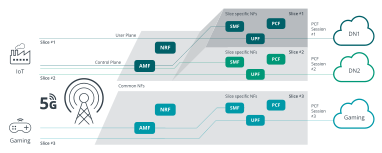
The following characteristics must be considered for each slice configuration:
- Slice isolation: Because network slicing requires the implementation of many diverse types of services, and some services share resources with other virtual slices, the isolation of a slice helps to ensure the quality of service.
- Diversification: Network slices can share network resources (for example, compute, storage, or bandwidth) with other network services; configuration to do so must be applied from the onset.
- Deployment: Advanced resource management of network resources is available for network slicing configurations to ensure rapid assignment of shared functions.
- Advanced management: Slice capabilities must allow subscribers to use diverse network functionalities while negotiating for quality of service.
The network characteristics listed above detail the basics that support “building blocks” for creating network slices. Slices can be implemented to ensure behavioral or functional performance.
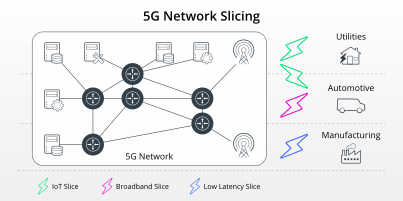
Figure 2 illustrates another example of network slicing, where a vehicle may need to have functions for a high-bandwidth slice for infotainment as well as an ultra-reliable slice to automatically collect and transmit sensor data about the driving experience.
Benefits of Network Slicing
Network slicing is important in emerging telecommunications networks such as 5G because, unlike previous technologies, 5G architecture and specifications have the capabilities to implement and deploy independent virtual network slices supporting enterprise and consumer requirements for a variety of 5G use cases:
- Enhanced mobile broadband (eMBB): A slice for general mobile internet use with high-speed data
- Massive machine-type communication (mMTC): A slice for many IoT devices (such as sensors) that connect simultaneously but do not require high speed
- Ultra-reliable low-latency communication (URLLC): A slice for critical applications, such as self-driving cars or remote surgery, that need extremely low latency and extremely high reliability
The full implementation of network slicing in 5G will benefit the industry by generating new revenue streams, reducing costs, and improving the quality of service and experience for customers.
NETSCOUT Solutions for 5G Network Slicing
NETSCOUT 5G solutions provide proven insights for network slices in support of service-level-agreement (SLA) management, automation, proactive analysis and monitoring, and scalability. Contact us to learn more about how NETSCOUT can help improve network slicing initiatives.